Journal entry testing
Risk tests over the whole journal, including Benford analysis, with every hit explained.
Marsad Finance prepares the hands-on work for every client overnight, on whatever system the client uses, so your team starts the day with decisions, not data entry.
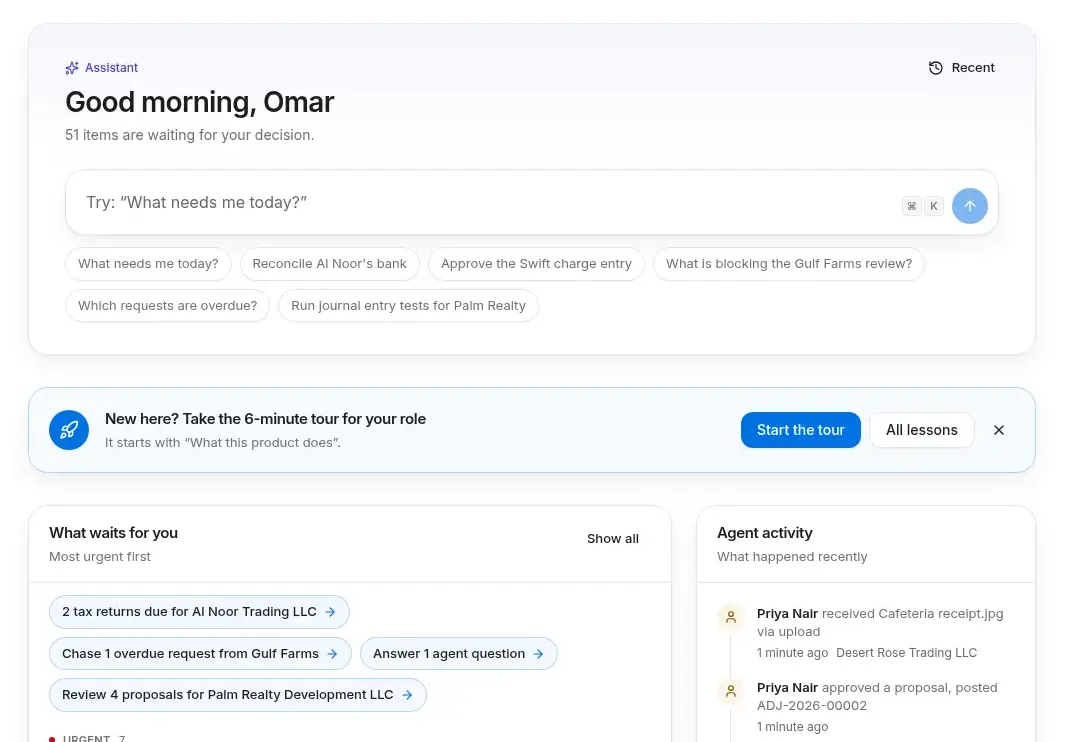
Agents work through the night; each person opens the app to a short list that is theirs to decide.
Agents reconcile banks, propose entries and refresh the working papers for every client.
Agent worksEach person sees only what they can decide, most urgent first. Nothing they raised themselves.
Person decidesThe reviewer checks the paper and its sources, leaves notes and signs the exact version.
Person decidesThe partner approves the final gate; the month locks and the binder is ready.
Always a personBring the old system's figures in as Excel or through a connector, choose the cutover date, and let the agent prepare M0: seven checks against what the client handed over.
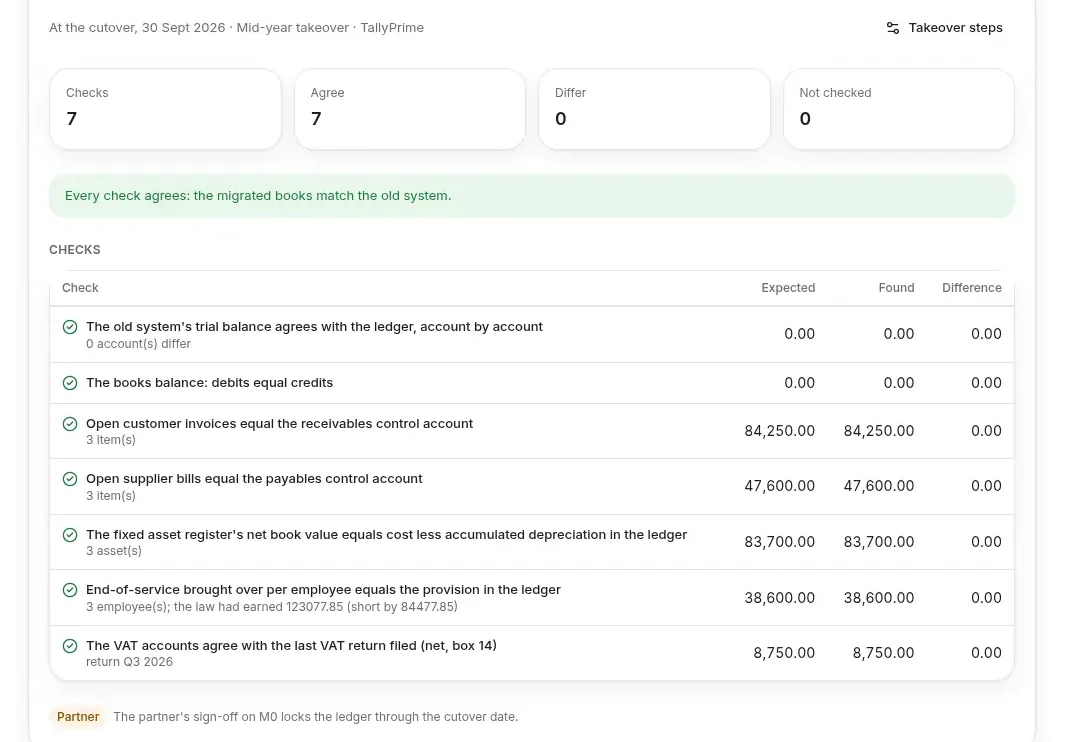
Each engagement runs through stages that agents prepare and gates that named people decide. Review notes, blockers and sign-offs are on the engagement, not in email.
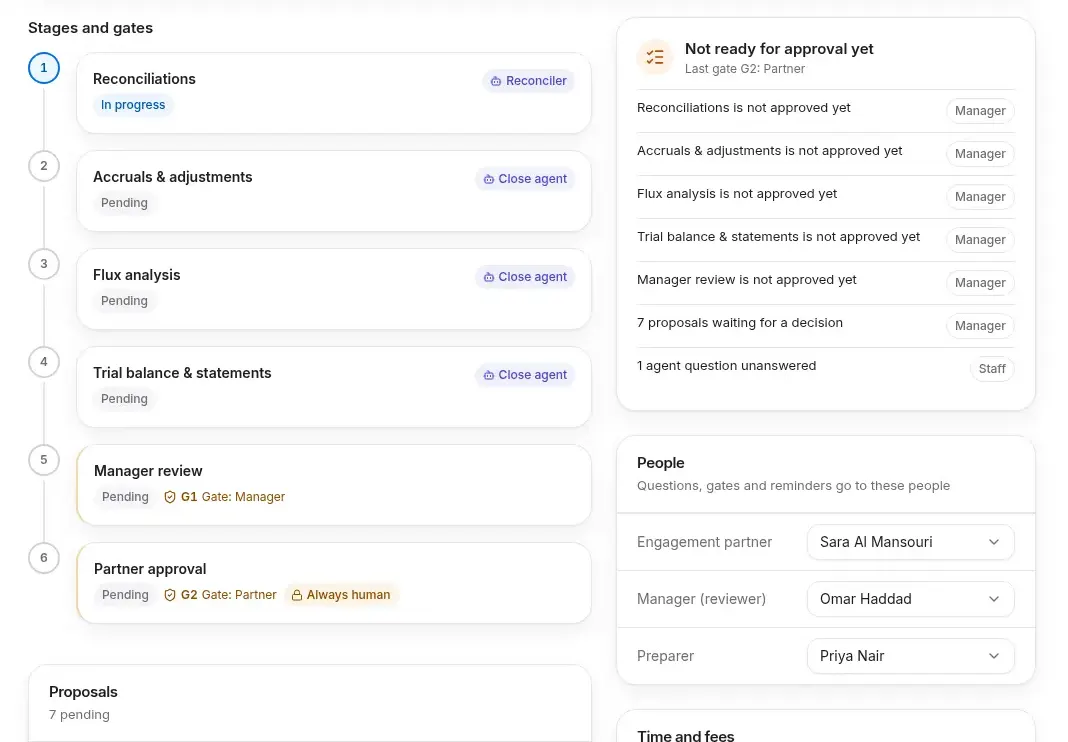
| Level | What happens | Who sets it |
|---|---|---|
| L0 · Manual | Agents start only when a person asks. | Manager |
| L1 · Auto-start (default) | Agents start each stage on their own; people decide every gate and every proposal. | Manager |
| L2 · Policy approvals | Two narrow rules may approve without a person: transaction coding at 95% confidence or more, and low-risk entries below the engagement's clearly trivial amount. Each one is logged and checked afterwards in a review queue. Switched on only once the agent has earned it on your own clients. | Partner |
The VAT return is built from the journal lines, by emirate, and reconciled to the VAT accounts. The Corporate Tax computation starts from accounting profit and shows every adjustment.
VAT and Corporate Tax are in beta. Regulatory points are marked “verify” for your tax team, and a person always files.
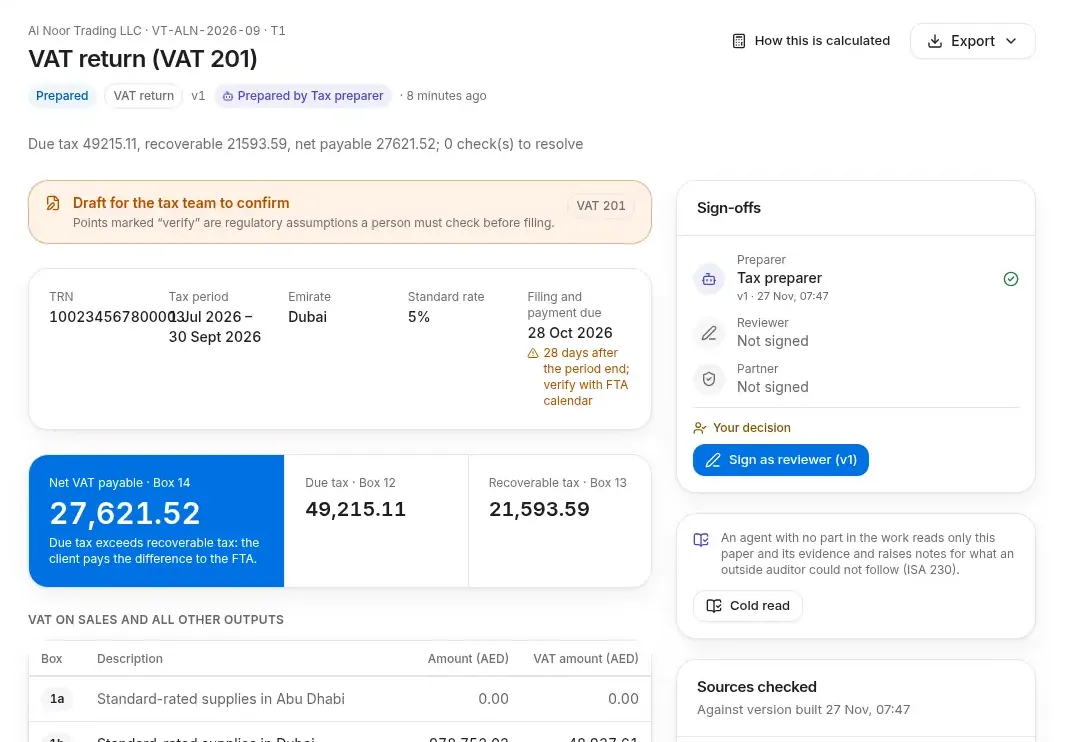
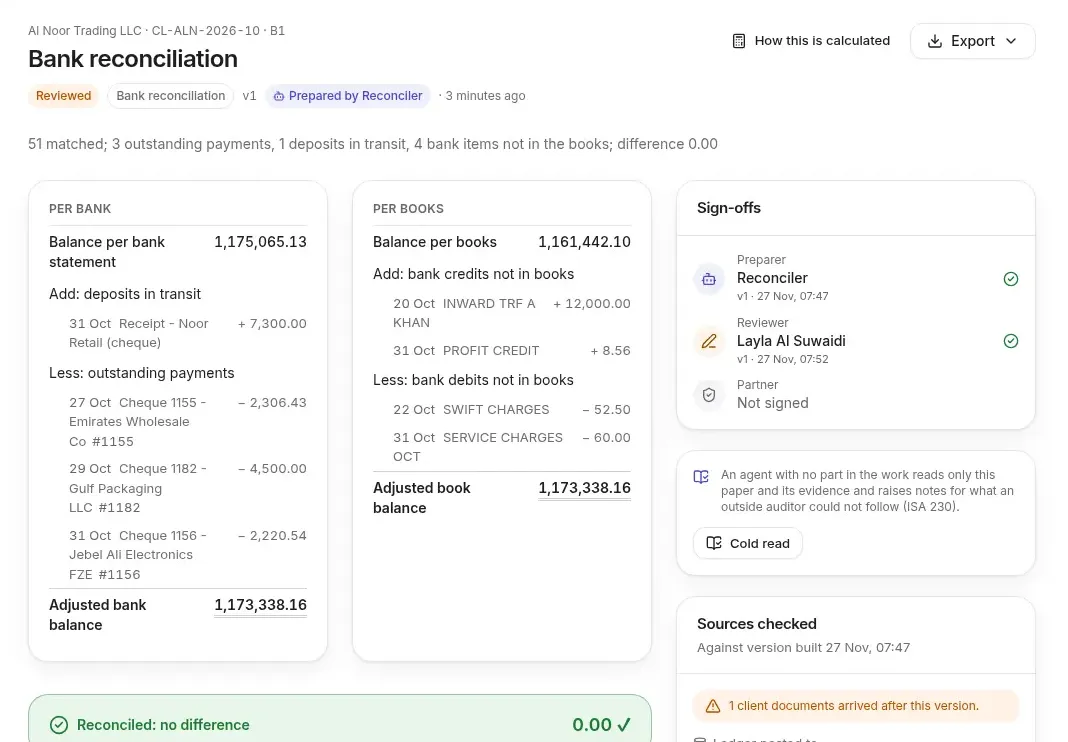
Every paper shows its figures, the rule behind them and the sources they came from, and exports on your letterhead.
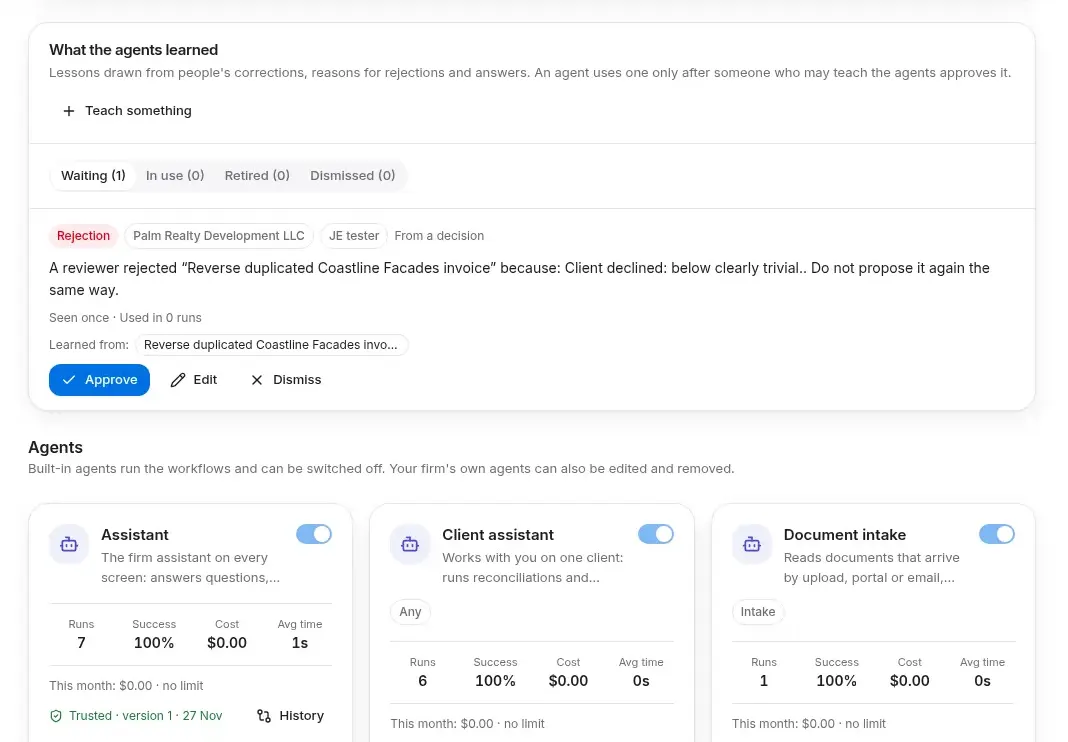
When someone corrects or rejects an entry and says why, the reason becomes a lesson for that client or for the whole firm, once a person allowed to teach the agents approves it.
Practice Everything adds the external audit: the same evidence, the same sign-offs, one audit trail.
Risk tests over the whole journal, including Benford analysis, with every hit explained.
Materiality by benchmark and risk, and samples drawn and documented for the file.
Cut-off tests around the period end, and confirmation requests to banks, customers and suppliers.
An agent checks the whole file before the opinion: sign-offs, open notes, materiality and sampling consistency.
Permissions follow the firm's own hierarchy, checked on every request. Nobody can change their own access.
| Role | Can approve or do |
|---|---|
| Partner | Partner sign-off and the final gates; policy approvals (L2); agent models; adding managers and partners; firm settings. |
| Manager | Reviewer sign-off; high-risk proposals; manager gates; posting to a client's system; pausing every agent. |
| Senior | Low- and medium-risk proposals; system connections and account mappings; reading and verifying the audit log. |
| Staff | Preparing work, importing files, answering agent questions and client requests. |
| Viewer | Reading the firm's work. |
| Client (portal) | Answering requests, uploading documents, proposing changes to their own details for a manager to approve. |
Priced per active client, a month. Reviewers and client-portal users are included.
For bookkeeping practices getting started.
For accounting firms with VAT and Corporate Tax clients.
Everything in Practice Essentials, plus
For audit and assurance firms.
Everything in Practice Standard, plus
Each firm's data is separated by the database itself, not only by the application. Your agreement names the hosting provider and region before any client data goes in, and the data stays there; a UAE region is available if you need one. In the pilot we work on anonymised data.
Yes. Every screen and every output exists in Arabic and English, written for UAE accountants rather than translated. Working papers come in Arabic, English or both side by side, and files with Arabic headers are read as they are.
It cannot post, file or sign on its own, so a mistake stops at a person. Figures come from tested calculation engines with exact decimals, not from the model's text, and every paper links to its sources. When you correct it and give the reason, it learns.
In the pilot you get a demo login the same day, and we compare one of your anonymised clients with your own figures within a week. A two-week trial on one real month follows.
Under UAE PDPL your firm stays the controller and Marsad Finance acts as your processor under a data processing agreement. Check that your engagement letters and privacy notice cover using a processor; we provide the agreement.
Yes. Every working paper exports to PDF and Excel, and each engagement exports as a binder with its documents, gate decisions and audit log.
Send one anonymised client and your own final figures. We run it through Marsad Finance and sit with you for 30 minutes to compare, line by line.
Limited pilot places for UAE firms and finance teams.